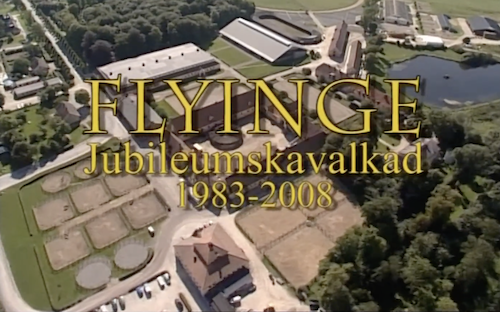
A historical film documenting Flyinge's transformation from the Swedish National Stud to a privately governed foundation, and the 25 years of leadership, development, and renewal that followed.
Flyinge traces its roots to the early Middle Ages, but by the 1950s the Swedish state had lost interest in its royal stud farm, and closure was seriously discussed. In 1983, responsibility for Flyinge, formerly the Swedish National Stud, was transferred from the state to the newly formed Stiftelsen Sveriges Avels och Hästsportcentrum Flyinge. This transition marked a decisive moment in Swedish equestrian history, and the creation of the foundation became a crucial effort to preserve and revitalize one of Sweden's most important equestrian institutions.
This film, produced by Mats Winqvist, brings together the four directors who led Flyinge from 1983 onward: Ingvar Fredricson (1983 to 1998), Roland Nilsson (1998 to 2003), Björn Leander (2003 to 2007), and Johan Bredberg (from 2007). Recorded in 2008 to mark the foundation's 25th anniversary, the conversation captures their reflections on leadership, challenges, and the long term development of Flyinge during a period of significant change for Swedish breeding and equestrian sport.
From the start, the foundation set three clear goals: qualified education, research/development, breeding/rearing, and hippological culture. Training programs grew from an eight week course for young grooms into a two year stable manager program whose graduates found work worldwide, and eventually into Hippologiska högskolan, Sweden's university level equine program. A new riding hall, funded largely by Swedish industry through Dr. PG Gyllenhammar and banker Hans Kavalli Björkman, gave the growing student body somewhere to train, and later expansions came with support from the Wallenberg Foundation.
Research at Flyinge spanned reproduction, biomechanics, and veterinary science, an area shaped in no small part by Fredricson's own background as a biomechanics researcher. But it is the stallions, and the horses and riders they produced, that the directors return to most fondly. Names like Robin Z, bought as a yearling and later a foundation sire in both sport and breeding, Cardento, who arrived green and left an Olympic horse, and Jaguar Mail, brought in to strengthen thoroughbred blood in the herd, run through the conversation alongside riders and trainers like Kyra Kyrklund, Peter Eriksson, Ulla Håkansson, and Jan Jönsson, whose skill and international success helped build Flyinge's reputation abroad.
For the Professor Fredricson Foundation, this film is an important piece of history, preserving the voices and experiences of the directors who shaped Flyinge, including Ingvar himself, who led the center for 15 of its first 25 years as a foundation.


%20copy.png)