Ingvar Fredricson: The Pioneer Who Transformed Equine Biomechanics
February 16, 2024
Professor Ingvar “Fredric” Fredricson — co‑founder of the Professor Ingvar Fredricson Foundation — laid the foundation for modern equine biomechanics in Sweden. His groundbreaking research on how horses move and interact with the ground reshaped training, racing surfaces, and today’s scientific understanding of performance and durability.
It began with a simple question: How does a horse truly move?
For Professor Ingvar “Fredric” Fredricson — co‑founder of the Professor Ingvar Fredricson Foundation — that question became a lifelong pursuit, one that reshaped equine science in Sweden and far beyond.
In the early 1970s, Fredric’s fascination with how horses’ legs move and how hooves meet the ground led him into uncharted territory. His research challenged assumptions, introduced new methods, and ultimately changed how racetracks were built. The sloping of curves on trotting tracks — now standard — was one of the early practical outcomes of his work.
After years of experimentation and innovation, he defended his doctoral thesis Equine joint kinematics and co‑ordination in 1972, marking the beginning of modern Swedish equine biomechanics.A major leap forward came when SLU in Uppsala built a locomotion laboratory equipped with a treadmill. With this new technology, Fredric and his colleagues could study movement in ways that had never been possible before.
Research into horse biomechanics developed rapidly when a locomotion laboratory with a treadmill was built at SLU in Uppsala. Photo: Ingvar Fredricson's photo archive
With the new laboratory in place, Fredric and his colleagues could study how horses’ legs move and how hooves land on different surfaces with unprecedented precision. This research led to practical, real‑world changes — including the sloping of curves on trotting racetracks worldwide.
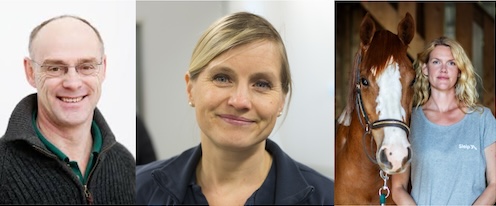
Today, the field he helped create has expanded dramatically. Research now spans footing quality, performance and durability, and advanced objective methods for diagnosing movement disorders and lameness. Following in Fredric’s footsteps are several leading researchers at SLU, including Lars Roepstorff, Marie Rhodin, and Elin Hernlund — all contributing to a rapidly evolving scientific landscape that Fredric helped shape. All three are recipients of the Foundation’s 2025 scholarship, continuing the work Fredric helped initiate more than fifty years ago.
Fredric’s story is one of curiosity, courage, and a relentless drive to understand the horse. It is also a reminder that groundbreaking science often begins with a single, persistent question.
Attribution: Adapted from HästSverige’s profile “Möt mannen bakom dagens biomekanikforskning.”
Dr Andrew McLean to Receive the Professor Ingvar Fredricson Foundation Scholarship at the 2026 Horse Welfare Summit
Two days. One shared goal: advancing horse welfare through science, education and practice. Join leading international experts at the Horse Welfare Summit 2026, where Dr Andrew McLean will deliver two keynote lectures and receive the Professor Ingvar Fredricson Foundation Scholarship.
The Smartphone's Growing Role in Sport Horse Management
A new review examines how smartphones are becoming genuine tools for monitoring a horse's soundness, heart rate and recovery, and even for meeting international competition requirements. Among the systems it highlights is Sleip, co-founded by Dr. Elin Hernlund, one of the Foundation's own scholarship recipients, whose work builds on decades of Swedish equine biomechanics research going back to Professor Ingvar Fredricson himself.
2025 Scholarship Awarded to Three World-Leading Biomechanics Researchers
On November 2, visitors gathered in Hall B at the Jönköping Horse Show for the Professor Ingvar Fredricson Foundation’s 2025 scholarship ceremony, celebrating groundbreaking Swedish research in equine biomechanics. From the pioneering efforts of the 1970s—when high‑speed cameras and manual measurements were the researcher’s tools—to today’s AI‑powered motion analysis and robotic hoof simulators, the audience was taken on a journey through decades of innovation. Professors Lars Roepstorff and Marie Rhodin, together with Associate Professor Elin Hernlund, shared their latest breakthroughs, followed by live demonstrations showing how AI and high‑precision sensors are transforming the understanding of horse–rider interaction. Moderator Jens Fredricson guided the dialogue and inspired exchange between researchers, while post‑event discussions with attendees helped build valuable bridges between research and practice.
The FEI Urges Equestrians to be Their Horses' Guardians
The FEI's guardian framework resonates with the work we champion at the Professor Fredricson Foundation. Advancing equestrian sport means placing the horse's welfare and wellbeing at the center — not as an afterthought, but as the foundation upon which all excellence is built.


%20copy.png)